
There are BBQ menus.
And then there are BBQ menus where someone has clearly decided:
“We’re eating properly tonight.”
This order was one of those.
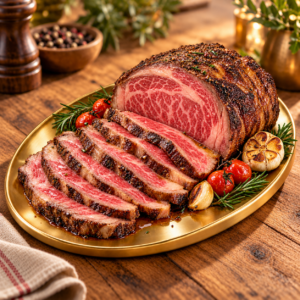
There was a Ribeye Roast.
MB6/7 Wagyu.
Lamb Rack.
Around 40 oysters.
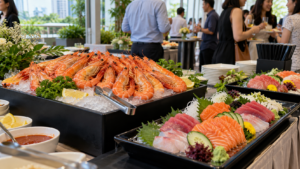
Seafood.
Skewers.
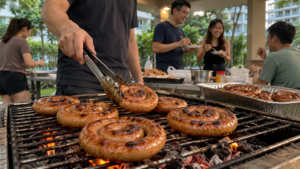
Sausages.
And the usual collection of things that somehow keeps growing once people start putting together a BBQ.
By the time everything was on the order, it had become one of our bigger premium BBQ jobs of the year.
Premium Doesn’t Have to Mean Formal
When people hear words like Wagyu, Ribeye Roast and oysters, the first image that comes to mind is often a restaurant.
White plates.
Small portions.
Everything arranged very carefully.
A BBQ is almost the opposite.
People are standing around.
Someone is holding a drink.
The grill is smoking.
Satay is disappearing faster than you can cook it.
And right beside all of that, somebody might be eating a slice of Wagyu.
We actually like that contrast.
Premium ingredients don’t necessarily need a formal setting to make sense.
Sometimes the nicest way to enjoy them is simply with friends around a BBQ.
Wagyu and Ribeye Roast Serve Different Purposes
Even though both are beef, we wouldn’t treat MB6/7 Wagyu and a Ribeye Roast as interchangeable.
The Wagyu carries much more marbling.
That extra intramuscular fat changes the richness, mouthfeel and the way it cooks.
A little can go a long way.
A Ribeye Roast works differently.
It’s a larger centrepiece.
It can be prepared carefully ahead of service, rested properly and sliced when people are ready to eat.
That also means the roast doesn’t have to occupy precious BBQ space while everything else is cooking.
For premium BBQ catering, that combination works particularly well.
The roast gives you something substantial and ready to carve.
The grill can concentrate on Wagyu, lamb, seafood, skewers and sausages.
Then Add Lamb Rack
Lamb Rack introduces another completely different texture and flavour.
It’s rich, but not in the same way as Wagyu.
And because the rack itself carries a good amount of fat around it, getting some colour and rendering on the outside matters.
Again, the point isn’t simply:
“Put expensive things on the BBQ.”
Different premium meats still need to be treated differently.
Otherwise you’re just paying more money to overcook nicer ingredients.
Oysters Change the Rhythm Completely
Then there were the oysters.
Around 40 of them.
Oysters are useful at a BBQ because they’re not competing with everything else for the grill.
They’re cold.
They’re immediate.
And they give guests something completely different from the beef, lamb and smoky food coming off the pit.
That’s something we’ve increasingly noticed when putting together bigger BBQ menus.
Contrast matters.
Hot and cold.
Rich and fresh.
Heavy and light.
A highly marbled piece of Wagyu tastes even richer when it isn’t the fifth heavy thing you’ve eaten in a row.
A BBQ Doesn’t Need One “Hero” Item
Sometimes people ask what the main item should be.
Steak?
Lamb?
Seafood?
For this kind of gathering, there doesn’t necessarily need to be one answer.
The Ribeye Roast can be the large centrepiece.
The Wagyu becomes the special few bites everybody talks about.
The Lamb Rack offers something different again.
The oysters break everything up.
The seafood, skewers and sausages keep the BBQ feeling like a BBQ.
That’s probably why we remember orders like this.
Not because there was one particular ingredient carrying the entire menu.
It was the variety.
The Grill Is Where Everything Meets
On an order sheet, these ingredients belong in completely different categories.
Premium beef.
Roasts.
Seafood.
Oysters.
BBQ meats.
Once the event starts, nobody really thinks about categories anymore.
Someone has Wagyu and an oyster on the same plate.
Someone else is waiting for lamb while eating a skewer.
The Ribeye Roast gets carved.
Another batch comes off the grill.
And eventually the menu becomes exactly what it was supposed to be:
Dinner.
A fairly serious dinner, admittedly.
But still dinner.