
When planning food for a group in Singapore, one of the first questions is usually simple, should you choose buffet catering or bento boxes?
Both options can work very well, but they solve different problems. Buffet catering gives guests more variety and a more social dining experience. Bento catering gives you structure, speed, portion control and cleaner distribution.

The right choice depends on your event type, number of guests, venue setup, schedule and how much flexibility you need. A casual family gathering may feel better with buffet trays, while an office meeting may run smoother with individually packed bentos.
It is also worth thinking about food waste. Singapore generated 784,000 tonnes of food waste in 2024, making up about 12% of total waste generated. That means portion planning is not just about cost, it is also about being practical and responsible.
What Bento Catering Is Good For.
Bento catering is best when you want things to be simple, fast and controlled. Each person gets one complete meal, packed individually and ready to eat.

This works very well for office lunches, seminars, workshops, school events, training sessions and meetings where people may not have time to queue. Instead of everyone gathering around a buffet table, bentos can be distributed quickly and eaten at desks, tables or meeting spaces.
The biggest advantage is portion control. If you have 30 people, you order 30 boxes. There is less guessing compared to buffet trays, where some dishes may finish quickly while others are left behind.
Bentos are also neater for indoor settings. There is no need for serving spoons, chafing dishes, queue space or shared trays. That matters if your venue is small, formal or time-sensitive.
Bento works best when:
- Guests need to eat quickly.
- The event has a fixed headcount.
- The venue has limited space.
- You want cleaner distribution.
- You want easier portion planning.
The downside is that bento boxes feel less flexible. Guests cannot choose larger or smaller portions, and they may have fewer options compared to buffet catering.
When Buffet Catering Makes More Sense.
Buffet catering works better when the event is more relaxed, social or flexible. Instead of fixed portions, guests can choose what they want and how much they want.
This makes buffet catering useful for family gatherings, company celebrations, festive meals, birthday parties, casual networking events and longer sessions where people may eat at different times.
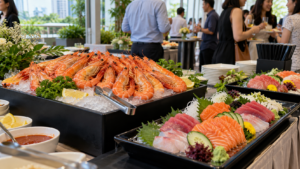
Buffets also allow you to offer more variety. You can have rice or noodles, meat, vegetables, sides and finger food all laid out together. For some events, this makes the meal feel more generous and festive.

The trade-off is that buffet catering needs more planning. You need enough table space, a sensible layout, serving utensils and sometimes warmers. Guests also need room to queue and move around.
Buffet works best when:
- Guests are eating casually.
- The event is longer.
- You want more variety.
- People may take different portion sizes.
- The venue has enough space for setup.
The main challenge is prediction. Some dishes may run out faster than expected, especially popular proteins. Others may be left untouched. This is where a good menu balance matters.
Portion Control and Food Waste.
This is one of the biggest differences between buffet and bento catering.
With bento catering, food planning is more predictable. You match the number of boxes to the number of guests. This can help reduce over-ordering, especially for office meals or fixed attendance events.
With buffet catering, you are planning by estimated consumption. Some people eat more, some eat less. Some dishes disappear quickly, while others may be left over. This is normal, but it means buffet planning needs more experience.

Food waste is a real issue in Singapore. In 2024, Singapore generated 784,000 tonnes of food waste, while the recycling rate for food waste was 18%. For event organisers, this is a reminder to plan portions properly, not just order “extra” out of fear.
As a simple rule:
- For fixed headcount meals, bento is usually easier.
- For social events with flexible eating, buffet may feel better.
- For mixed groups, consider slightly smaller buffet portions with a few strong crowd favourites.
The goal is not to underfeed people. The goal is to order smartly so the food is enjoyed instead of wasted.
Space and Setup Considerations.
Space is another major factor.
A buffet needs a proper table setup. You need space for trays, serving spoons, plates, cutlery and guest flow. If the area is cramped, a buffet can quickly feel messy.
Bento boxes need much less setup. They can be stacked, distributed or placed on a table for collection. This is why bentos work well in meeting rooms, offices, classrooms and training spaces.

Time also matters. If your guests only have 30 minutes to eat, bento is usually more efficient. If the event has a more relaxed schedule, buffet gives people the chance to come back for seconds and enjoy the meal at their own pace.
Think of it this way:
- Small room, short meal time: bento.
- Open space, casual eating: buffet.
- Formal meeting: bento.
- Celebration or gathering: buffet.
Guest Experience, Which Feels Better?
This depends on the mood of the event.
Buffet catering feels more communal. People move around, choose dishes and interact. For celebrations, this can make the event feel warmer and more generous.

Bento catering feels more organised. Guests receive their own meal without waiting too long. For meetings and seminars, this can feel more respectful of time.
There is no universal winner. A bento may feel too rigid for a festive gathering, while a buffet may feel too messy for a formal seminar. The best choice is the one that matches the flow of the event.
A good way to decide is to ask:
- Will people be seated most of the time?
- Is the schedule tight?
- Do guests need to network and mingle?
- Is the venue formal or casual?
- Do you need fast cleanup?
Once you answer these, the right format becomes much clearer.
Which One Should You Choose?
Choose bento catering if you want convenience, clean distribution and predictable portions. It is especially useful for corporate lunches, meetings, seminars, school events and packed schedules.
Choose buffet catering if you want variety, flexibility and a more social dining experience. It works better for family events, celebrations, casual gatherings and longer meal periods.
For many organisers, the best answer comes down to the venue and schedule. If your guests have limited time and limited space, bento is usually safer. If the event is more relaxed and you want guests to enjoy variety, buffet makes sense.
The most important thing is to match the food format to the event, not just choose based on what looks more impressive.
Conclusion.
Buffet and bento catering both have their place. Bento gives structure, speed and portion control. Buffet gives variety, flexibility and a more communal feel.
The better choice depends on your headcount, venue, schedule and the kind of experience you want your guests to have.
Plan around how people will actually eat, not just how the food looks on the table. That is usually the difference between a smooth meal and a stressful one.
Planning a team meal, small gathering or event? Choosing the right format early can save a lot of hassle later. Whether you need individual bento boxes or a shared catering spread, De’Vour can help you plan a setup that fits the occasion.
View our catering options here: Catering & Cooked Food – De’Vour | BBQ. Roasts. Catering