
Some orders are very easy to categorise.
BBQ.
Roast dinner.
Buffet.
Bento.
This one was a little harder.
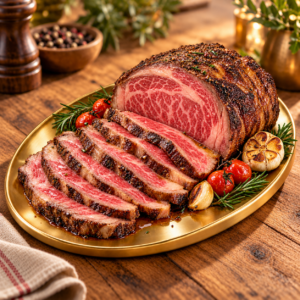
There was a Tajima Ribeye Roast.
Braised Lamb Shank with Mashed Potatoes.
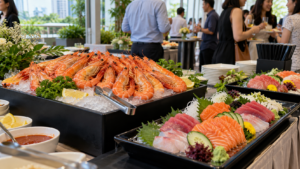
Eight Colossal Tiger Prawns.
Cold Truffle Somen with Hotate and Ikura.
Bluefin Tuna Chutoro.
Ten Hyogo Oysters.
Charred Romaine with Caesar Dressing and Bacon Bits.
And a Cheese Platter.
This wasn’t really a conventional buffet.
It wasn’t exactly a roast dinner either.
It was closer to taking several things people might normally order at different restaurants and putting them together for one meal at home.
Which, if we’re being fair, sounds like a pretty good evening.
Private Catering Doesn’t Have to Mean Chafing Dishes
The word catering still makes a lot of people picture long buffet tables.
Stainless-steel warmers.
Rice at one end.
Dessert at the other.
That is one version of catering.
But smaller private catering in Singapore can look completely different.
Sometimes you’re not trying to feed 200 people.
You’re trying to put together a really good dinner for a smaller group without asking the host to cook every component themselves.
That opens up a very different kind of menu.
Start With Tajima Ribeye Roast
The beef on this order was a 500g Tajima Ribeye Roast intended for sharing.
That is a much smaller format than some of the multi-kilogram roasts we prepare for larger events.
And that’s exactly why it works here.
The beef doesn’t have to feed the entire table.
It is one part of the meal.
A few slices each.
Enjoy the richness.
Then move on.
With premium beef, that can actually be a nicer way of eating than expecting everyone to finish one enormous steak.
Braised Lamb Shank Brings the Comfort Food
Then, completely changing direction, there were two Braised Lamb Shanks with Mashed Potatoes.
This is the kind of dish that isn’t trying to be delicate.
Slow-cooked meat.
Mash.
Rich sauce.
Comfort food.
Put that beside Tajima Ribeye and the meal suddenly has two very different kinds of meat experience.
One is about roast beef and marbling.
The other is about slow cooking until the meat becomes tender.
They don’t need to match.
They just need to taste good.
Then the Seafood Gets Serious
The seafood side of this menu was where things became particularly interesting.
Eight Colossal Tiger Prawns.
Bluefin Tuna Chutoro.
Hyogo Oysters.
And Cold Truffle Somen with Hotate and Ikura.
That is a pretty dramatic change from Lamb Shank and mashed potatoes.
But this is also how people actually like to eat when they have a choice.
A little roast beef.
An oyster.
Some sashimi.
Pasta or noodles.
A prawn.
Back to the beef.
Nobody is issuing penalties for breaking the sequence.
Cold Truffle Somen Works Because Not Everything Needs to Be Hot
When a menu contains several hot, rich dishes, cold food becomes particularly useful.
Our Cold Truffle Somen with Hotate and Ikura gives the table something completely different in temperature and texture.
The noodles are chilled.
The scallop is delicate.
The ikura adds salinity.
And the truffle brings richness without needing another piece of meat.
This kind of contrast matters more than trying to make every dish belong to one cuisine.
A meal can move between temperatures as easily as it moves between flavours.
Oysters and Chutoro Change the Pace of Dinner
Oysters are immediate.
Open.
Eat.
Done.
Chutoro asks for a completely different kind of attention.
The texture and fat are the point, so you don’t need a huge serving.
Both are relatively light compared with the roast and Lamb Shank.
That gives the table a way to slow down between the heavier dishes.
It’s one reason seafood works so naturally inside a premium home catering menu.
You don’t have to make seafood the whole meal.
It can simply give the meal somewhere else to go.
Even the Salad Wasn’t Just There Because We Felt Guilty
The Charred Romaine came with Caesar dressing and bacon bits.
Which means nobody can accuse it of being aggressively healthy.
But it does its job.
Something crisp.
Something green.
A little acidity.
A break between the rich food.
The Cheese Platter does the opposite.
It gives everyone something to keep picking at later when the formal part of dinner has basically ended but nobody is quite ready to stop eating.
This Is What Premium Home Dining Can Look Like
There is sometimes an assumption that if you want premium food, you need to go somewhere formal.
You don’t.
A private dinner can have premium beef, sashimi-grade seafood, oysters and carefully prepared sides while everyone is still sitting around someone’s home.
The setting can remain relaxed.
The food doesn’t have to.
For us, that’s an interesting space between restaurant dining and conventional catering.
The host doesn’t need a commercial kitchen.
They don’t need to cook eight separate components.
And the menu can be far more personal than a fixed restaurant set.
A Good Menu Doesn’t Have to Make Sense on Paper
Tajima Ribeye.
Lamb Shank.
Tiger Prawns.
Truffle Somen.
Chutoro.
Oysters.
Charred Romaine.
Cheese.
If somebody asked us to name the cuisine, we’d probably give up.
But that isn’t really the point.
It’s a collection of food somebody wanted to eat.
And sometimes that is a much better way to build dinner.